
Why Dog Hair Keeps Clogging Self-Service Dog Wash Machines (And What Actually Works)
2026-04-13
The Real Reason Dog Wash Machines Keep Getting Clogged
If you operate a self-service dog wash machine, clogging is probably not new to you.
At first, everything seems fine.
But after several washes—especially with long-haired dogs—you start to notice the signs:
But after several washes—especially with long-haired dogs—you start to notice the signs:
-
Water draining more slowly
-
Hair collecting around the base
-
Occasional standing water after use
Eventually, the machine needs to be stopped for cleaning.
And during busy hours, that means lost revenue.
And during busy hours, that means lost revenue.
This is one of the most common dog wash station maintenance issues—and it’s often underestimated.
Why Dog Hair Becomes a Drainage Problem
Dog hair alone isn’t the problem.
The issue comes from how it behaves during washing.
The issue comes from how it behaves during washing.
In a typical pet wash station, dog hair mixes with water and shampoo, forming a dense, sticky mass.
How Hair Actually Causes Blockage
Instead of flowing away smoothly, it tends to:
-
Clump together
-
Stick to surfaces
-
Accumulate at drainage points
Most importantly, many machines rely on a single drainage outlet with limited filtration.
This creates a bottleneck.
When all water and hair are forced through one point, clogging becomes almost unavoidable—especially in high-frequency usage environments.
When all water and hair are forced through one point, clogging becomes almost unavoidable—especially in high-frequency usage environments.
What Most Operators Try (And Why It’s Not Enough)
To deal with clogging, operators usually increase cleaning frequency:
-
Removing visible hair after each wash
-
Rinsing the drain area more often
-
Manually clearing filters
Why These Methods Only Work Short-Term
These actions can reduce buildup temporarily.
But they don’t solve the root issue.
But they don’t solve the root issue.
Because the problem isn’t just maintenance—
it’s how the machine handles hair flow internally.
it’s how the machine handles hair flow internally.
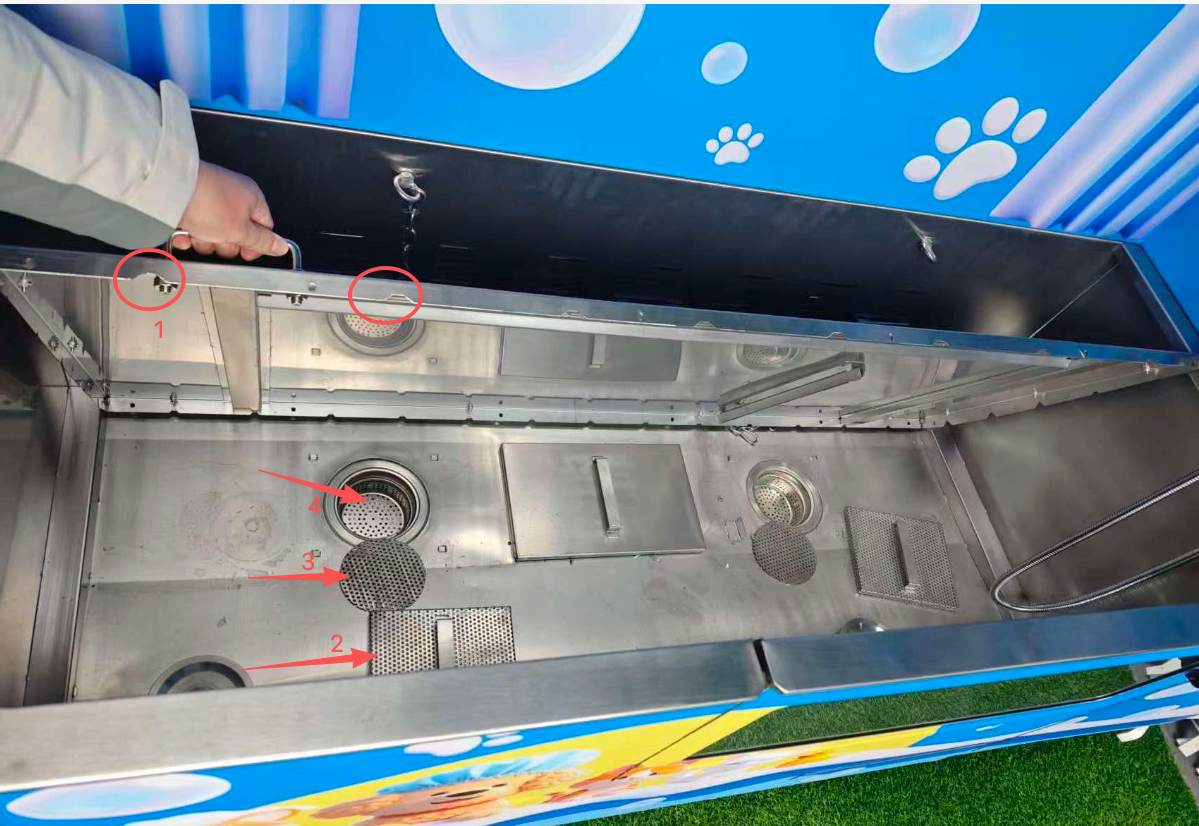
A More Effective Design: Dual Drains with Layered Filtration
Instead of relying on a single drain, a more practical solution is to distribute both flow and filtration load.
Step 1: Base-Level Intake (Side Openings)
Water and dog hair enter through openings along the sides of the base platform.
This creates a controlled and even downward flow.
This creates a controlled and even downward flow.
Step 2: Dual Drain Channels
Under the base, the flow is split into two separate drainage outlets.
Instead of concentrating everything in one location, the system distributes the load across two channels.
Step 3: Triple-Layer Filtration (Per Drain)
Each drain is equipped with three removable filter layers:
-
A top filter for larger hair and debris
-
A middle mesh layer for finer hair
-
A deeper filter protecting pipes and pumps
Because both drains operate simultaneously, the filtration workload is shared—significantly reducing the chance of blockage.
Why This Matters in Daily Operation
For operators, the difference becomes clear over time.
Instead of dealing with sudden clogs, the system remains stable even during peak usage.
Operational Benefits You’ll Notice
-
More consistent drainage performance
-
Easier and faster cleaning (removable filters)
-
Reduced risk of unexpected downtime
In practical terms, this leads to:
-
Fewer interruptions during busy hours
-
Lower dog wash machine maintenance frequency
-
Reduced long-term repair costs
Choosing a Self-Service Dog Wash Machine That Lasts
If you’re planning to invest in a self-service pet wash station, filtration design should not be overlooked.
Many machines may look similar externally.
But internally, the difference between systems is significant.
But internally, the difference between systems is significant.
What Actually Makes the Difference
-
A single-drain system
vs. -
A dual-drain, multi-layer filtration system
This difference directly impacts your daily operations.
A well-designed machine doesn’t just improve washing efficiency—it helps you avoid constant maintenance issues.
Final Thought: It’s Not Just Hair—It’s System Design
Dog hair clogging is a natural part of running a pet wash station.
But frequent blockage and downtime don’t have to be.
But frequent blockage and downtime don’t have to be.
With a system that combines dual drainage and triple-layer filtration, operators can:
-
Manage hair flow more effectively
-
Reduce maintenance pressure
-
Keep machines running reliably—even in high-traffic environments
In the end, the goal is simple:
less time fixing problems, more time serving customers.
less time fixing problems, more time serving customers.
Global Vending Machine Market 2026: Trends, Best-Selling Models, and Real ROI Logic
Visit WEIMI at AVE 2026: Proven Smart Vending Solutions
Related Article

Learn about card, contactless, QR code, and mobile payment options for modern vending machines and how to choose between them.
Vending Machine Payment Systems: Card, QR Code and Mobile Payments

Learn how to choose a vending machine based on your products, location, capacity, payment options, and daily operating needs.
How to Choose the Right Vending Machine for Your Business

